Basketball
Basketball questions
Youth basketball rules change at every border, so most answers here go country by country: the Netherlands, Flanders, Wallonia, Germany, Austria, Switzerland, France and Luxembourg. The source is under each answer.
On this page
Which age categories does youth basketball use in each country?
Every federation counts in U-categories, but cut-off dates and category widths differ. Netherlands: U8, U10, U12, U14, U16, U18, U19, U20, U21, U22, Senioren, by age on the first of January of the season; U8 plays club tournaments and regular competition starts at U10. Flanders puts two birth years in each youth category; boys go up to U21, girls to U19. Wallonia publishes no category table, so check with the AWBB. Germany: one class per birth year, U8 to U20, cut-off on the last day of December. Austria: mini rules for U9 to U12; a player may not reach the class age in the year the championship starts. Switzerland: mini rules for U6, U8, U10, U12, with no published cut-off. France: age on the first of January; mini basketball is U7, U9 and U11, ages 6–11. Luxembourg: U8, U10, U12, two birth years each. The same label can mean a different age abroad.
- Source: NBB kennishub, Leeftijdscategorieën (checked 20 October 2026)
- Source: NBB kennishub, Minibasketbal U08–U12 (checked 20 October 2026)
- Source: Basketbal Vlaanderen, Leeftijdscategorieën 2026-2027 (checked 20 October 2026)
- Source: DBB Jugendspielordnung (Mai 2025) (checked 20 October 2026)
- Source: Basketball Austria, Mini-Basketball Regeln (2024) (checked 20 October 2026)
- Source: Swiss Basketball, Règles de jeu catégories U6–U12 (checked 20 October 2026)
- Source: FFBB Annexes aux Règlements Généraux 2026/2027, annexe 2 (checked 20 October 2026)
- Source: FFBB Règlement National MiniBasket 2026/2027 (checked 20 October 2026)
- Source: FLBB, Mini Basketball page (checked 20 October 2026)
How high is the basketball ring for U8, U10, U12 and U14?
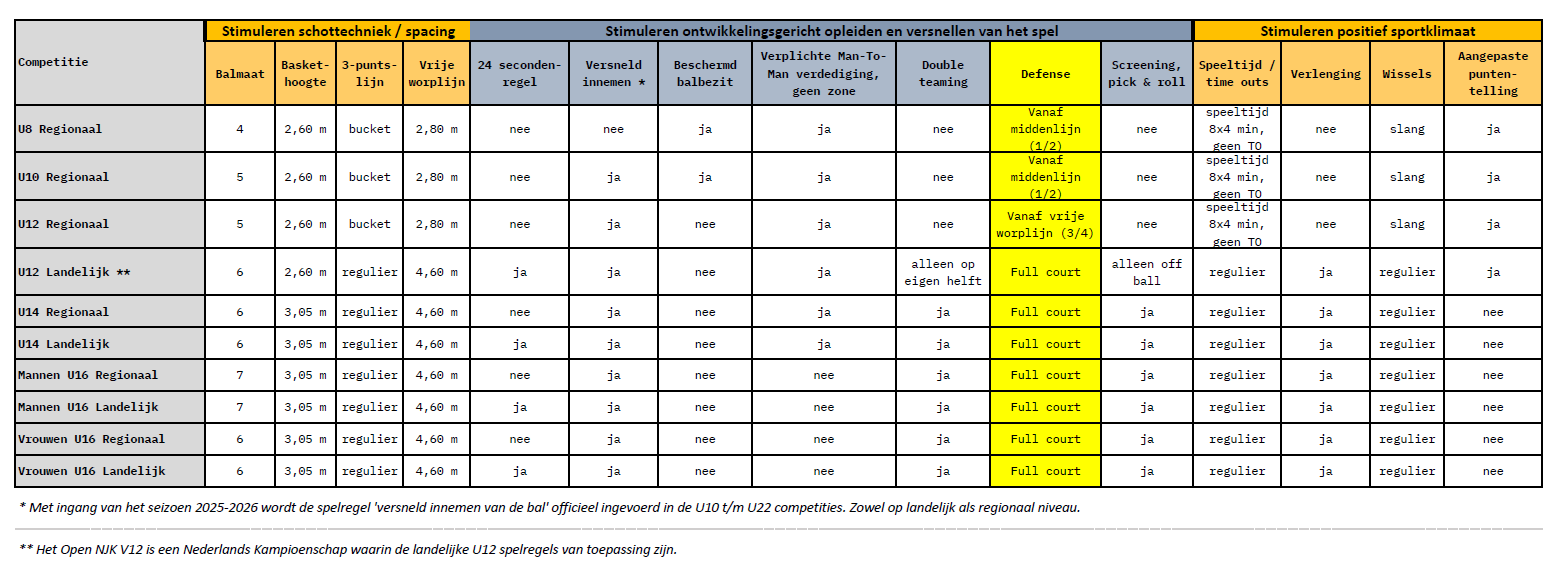
Most mini basketball is played on a ring at 2.60 m; the step to the adult ring comes at a different age in each country. Netherlands: 2.60 m up to U12, Regionaal and Landelijk, 3.05 m from U14. Flanders: 2.60 m at U8 to U12, 3.05 m at U14. Wallonia: the low ring in every mini format, as a maximum at 3x3 and 4x4. Germany: U8 2.05–2.60 m, U10 and U12 2.60 m. Austria: 2.60 m from U9 to U12, 3.05 m from U13. Switzerland: U6 2.10 m, U8 and U10 2.60 m, U12 already 3.05 m. France: U9 and U11 2.60 m, U7 that height or lower, 3.05 m from U13. Luxembourg: U10 2.60 m, U12 2.80 m, a step in between. So a Swiss U12 player shoots at the adult ring, a Dutch, Flemish or Austrian one at the low ring. Try rainbow shots.
- Source: NBB Aanvullende wedstrijdbepalingen 2026-2027 (overview table) (checked 20 October 2026)
- Source: Basketbal Vlaanderen, Poster spelregels minibasketbal 2026-2027 (checked 20 October 2026)
- Source: AWBB, Formes de jeux du Mini Basket (checked 20 October 2026)
- Source: DBB Spielregeln Minibasketball 2024 (checked 20 October 2026)
- Source: Basketball Austria, Mini-Basketball Regeln (2024) (checked 20 October 2026)
- Source: Swiss Basketball, Règles de jeu catégories U6–U12 (checked 20 October 2026)
- Source: FFBB Annexes RG 2026/2027, annexe 3 (checked 20 October 2026)
- Source: FLBB Règlements administratifs (juin 2026), Règlement de jeu Mini Basketball (checked 20 October 2026)
Which ball size does each age group play with in youth basketball?
Children start on a small ball and move up a size at an age each federation sets for itself. Netherlands: size 4 at U8, 5 at U10 and U12 Regionaal, 6 at U12 Landelijk and U14; at U16 boys play size 7, girls size 6. Flanders: size 4 at U8, 5 from U10 to U14. Wallonia: size 5 in every mini format, lighter at 3x3. Germany: size 4 at U8, 5 at U10 and U12, with lighter models allowed at U10. Austria: size 4 at U9, 5 from U10 to U13. Switzerland: size 4 at U6 (a soft ball) and U8, 5 at U10 and U12. France: sizes 4–5 at U9, 5 at U11, 6 at U13; from U15 boys play size 7, girls size 6. Luxembourg: size 5 at U10 and U12, 6 at U14. FIBA advises an even smaller ball for the youngest.
- Source: NBB Aanvullende wedstrijdbepalingen 2026-2027 (checked 20 October 2026)
- Source: Basketbal Vlaanderen, Poster spelregels minibasketbal 2026-2027 (checked 20 October 2026)
- Source: AWBB, Formes de jeux du Mini Basket (checked 20 October 2026)
- Source: DBB Spielregeln Minibasketball 2024 (checked 20 October 2026)
- Source: Basketball Austria, Mini-Basketball Regeln (2024) (checked 20 October 2026)
- Source: Swiss Basketball, Règles de jeu catégories U6–U12, point 4 (checked 20 October 2026)
- Source: FFBB Annexes RG 2026/2027, annexe 3 (checked 20 October 2026)
- Source: FLBB Règlements administratifs (juin 2026), Règlement de jeu Mini Basketball (checked 20 October 2026)
- Source: FIBA Mini Basketball Dos and Don'ts (checked 20 October 2026)
Do children play 3v3, 4v4 or 5v5 basketball, and on how big a court?
The Netherlands plays 5v5 from the start; Flanders and Luxembourg build up from 3v3. Netherlands: the NBB substitution schedules for U8 to U12 put 5 players on court, for squads of 6–12. Lower youth divisions need a court of at least 25–26 m by 13–14 m, the top youth leagues 26–28 m by 14–15 m. Flanders: U8 plays 3v3 on 14 m by 14 m, rings 10–12 m apart; U10 4v4 on 14 m by 21 m, rings 15–18 m apart; U12 5v5 on 14 m by 28 m; at most 12 players a squad. Wallonia: 3x3, 4x4 and 5x5, each with its own squad size. France: U9 3x3 or 4x4, U11 4x4, 5x5 for advanced players. Luxembourg: U10 3 and U12 4 a side, on a normal court. Adults: 28 m by 15 m. Germany, Austria and Switzerland have their own question below.
- Source: NBB Wisseltechniek U8-U10-U12 (slangenmodel) (checked 20 October 2026)
- Source: NBB kennishub, Zaaleisen & zaaldispensaties, minimale veldafmetingen (checked 20 October 2026)
- Source: Basketbal Vlaanderen, Minibasketbal U8-U10-U12 page (checked 20 October 2026)
- Source: Basketbal Vlaanderen, Poster spelregels minibasketbal 2026-2027 (checked 20 October 2026)
- Source: Basketbal Vlaanderen, Minibasketbal (U6-U8-U10-U12) page and poster 2026-2027 (checked 20 October 2026)
- Source: AWBB, Formes de jeux du Mini Basket (checked 20 October 2026)
- Source: FFBB Règlement National MiniBasket 2026/2027, art. 1 (checked 20 October 2026)
- Source: FLBB Règlements administratifs (juin 2026), Règlement de jeu Mini Basketball (checked 20 October 2026)
- Source: FIBA Official Basketball Rules 2026 (checked 20 October 2026)
May a youth basketball team play zone defence, or is man-to-man compulsory?
Man-to-man is compulsory in every youth mini rule book, and zone defence is not allowed. Netherlands: man-to-man up to and including U14, each defender within two metres of their player; help and rotation are allowed, and zone is free from U16. Flanders: man-to-man within an arm's length from U8 to U14. Wallonia: individual defence, help allowed, no trap. Germany: man-to-man from U8 to U12. Austria: man-to-man from the centre line, U9 to U12. Switzerland: individual defence from U8 to U12. France: individual defence at U7 and U9. Luxembourg: individual defence at U10 and U12, and no zone or mixed defence up to U16. FIBA advises no zone before 14 years of age. So defence training at these ages is 1v1 and help, not zone shapes, as in one v one with a helper.
- Source: NBB kennishub, Aangepaste regels U8 t/m U12 (checked 20 October 2026)
- Source: NBB Aanvullende wedstrijdbepalingen 2026-2027 (checked 20 October 2026)
- Source: Basketbal Vlaanderen, Poster spelregels minibasketbal 2026-2027 (checked 20 October 2026)
- Source: AWBB, Formes de jeux du Mini Basket (checked 20 October 2026)
- Source: DBB Spielregeln Minibasketball 2024 (checked 20 October 2026)
- Source: Basketball Austria, Mini-Basketball Regeln (2024), § 9 (checked 20 October 2026)
- Source: Swiss Basketball, Règles de jeu catégories U6–U12, rules point (checked 20 October 2026)
- Source: FFBB Règlement National MiniBasket 2026/2027, art. 4 (checked 20 October 2026)
- Source: FLBB Règlements administratifs (juin 2026), Règlement de jeu Mini Basketball, art. 13; U14 art. 5; FLBB Youth Basketball Rules (U14 and U16) (checked 20 October 2026)
- Source: FIBA Mini Basketball Dos and Don'ts ("Zone defence should not be played until 14 years of age") (checked 20 October 2026)
Are screens, pick-and-roll, double teams and pressing allowed in youth basketball?
Most federations ban screens and double teams in mini basketball, each until its own age. Netherlands: no screens at U8, U10 and U12 Regionaal, off-ball only at U12 Landelijk, free from U14; double teams follow the same steps, own half only at U12 Landelijk. Defence starts at the half-way line at U8 and U10, at the opponents' free-throw line at U12 Regionaal, full court from U12 Landelijk. Flanders: no screens up to U14, where a dribble hand-off is allowed. After a score U8 and U10 drop back to their own half; U12 may press full court, without trapping, up to a 20-point lead. Wallonia: no screens, no trap. Germany: no screens, hand-offs or double teams; full-court defence is allowed. Austria: no screens of any kind, no double teams, full-court press from U12 until a team leads by 15 points. Switzerland: no screens. Luxembourg: no screens or double teams. France publishes no rule on this.
- Source: NBB kennishub, Aangepaste regels U8 t/m U12 (checked 20 October 2026)
- Source: Basketbal Vlaanderen, Poster spelregels minibasketbal 2026-2027 (checked 20 October 2026)
- Source: AWBB, Formes de jeux du Mini Basket (checked 20 October 2026)
- Source: DBB Spielregeln Minibasketball 2024 (checked 20 October 2026)
- Source: Basketball Austria, Mini-Basketball Regeln (2024) (checked 20 October 2026)
- Source: Swiss Basketball, Règles de jeu catégories U6–U12, rules point (checked 20 October 2026)
- Source: FLBB, 2024 Mini Basketball Rules (checked 20 October 2026)
- Source: FLBB Règlements administratifs (juin 2026), Règlement de jeu Mini Basketball, art. 13; U14 art. 5; FLBB Youth Basketball Rules (U14 and U16) (checked 20 October 2026)
May a defender take the ball out of a young player's hands?
Not at the youngest ages: in mini basketball the ball in a player's hands is protected. Netherlands: at U8 and U10 nobody may grab or slap the ball out of a player's hands, but intercepting a dribble or a pass is allowed. Flanders protects the ball at U8 only. Wallonia forbids all contact at 3x3, and at 4x4 and 5x5 contact on the ball handler, players off the ball and the shooter. France: at U9 and U11 taking the ball out of the hands is forbidden; the ball goes back to the attackers. Germany, Austria, Switzerland and Luxembourg publish no such rule, so check with your own federation. So defence at these ages is about position and reading the pass, as in passing over a guarded middle zone.
- Source: NBB kennishub, Aangepaste regels U8 t/m U12 (checked 20 October 2026)
- Source: Basketbal Vlaanderen, Poster spelregels minibasketbal 2026-2027 (checked 20 October 2026)
- Source: AWBB, Formes de jeux du Mini Basket (checked 20 October 2026)
- Source: FFBB Règlement National MiniBasket 2026/2027, annexe 1 (checked 20 October 2026)
Does every child get the same playing time in youth basketball?
Yes: in mini basketball playing time is a rule of the match, not the coach's choice. Netherlands: U8, U10 and U12 Regionaal play 8 periods of 4 min with no time-outs, and the snake rotation is compulsory; the score freezes at a 50-point lead. Flanders: the snake system at U8 and U10, with one exceptional substitution per quarter at U10; at U12 every player must have played and rested. Wallonia: at 4x4 everyone plays the same number of periods, give or take one. Germany: every child plays at least 2 periods and sits out as many, with substitutions only in the breaks. Austria: the same minimum of 2 periods, or the game is lost. Switzerland: at U8 and U10 nobody plays more than one period more than the player who played least; at U12 nobody plays all four quarters. France: players share the time equally. Luxembourg: at U12 at least two periods, never more than two in a row.
- Source: NBB kennishub, Aangepaste regels U8 t/m U12 (checked 20 October 2026)
- Source: Basketbal Vlaanderen, Poster spelregels minibasketbal 2026-2027 (checked 20 October 2026)
- Source: AWBB, Formes de jeux du Mini Basket (checked 20 October 2026)
- Source: DBB Spielregeln Minibasketball 2024 (checked 20 October 2026)
- Source: Basketball Austria, Mini-Basketball Regeln (2024) (checked 20 October 2026)
- Source: Swiss Basketball, Règles de jeu catégories U6–U12, point 10; Système passerelle (checked 20 October 2026)
- Source: FFBB Règlement National MiniBasket 2026/2027, art. 4 (checked 20 October 2026)
- Source: FLBB Règlements administratifs (juin 2026), Règlement de jeu Mini Basketball, art. 8 and 10; U14 art. 2 (checked 20 October 2026)
How far is the free-throw line for children, and when does a basket count three?
Mini basketball moves the free-throw line closer and changes the three-pointer. Netherlands: up to U12 Regionaal, 2.80 m to the backboard and outside the key counts three; then 4.60 m. Flanders: U10 shoots from 3 m; U12 and U14 have no published distance. Wallonia: 3.50 m at 4x4, 4 m at 5x5, none at 3x3. Germany: 2 m forward at U8, 1 m at U10 and U12; threes from outside the key from U10. Austria: 1 m forward at U9 and U10, 0.50 m at U11 and U12, and outside the key counts three. Switzerland: no free throws at U6 and U8, a closer line at U10 if both coaches agree, where outside the key counts three. France: the line suits the child; no threes at U7 and U9. Luxembourg: no free throws at U10, 4 m from the backboard at U12 and U14, no threes at U10 and U12. Adults: free-throw line 5.80 m, arc 6.75 m.
- Source: NBB kennishub, Aangepaste regels U8 t/m U12 (checked 20 October 2026)
- Source: Basketbal Vlaanderen, Poster spelregels minibasketbal 2026-2027 (checked 20 October 2026)
- Source: AWBB, Formes de jeux du Mini Basket (checked 20 October 2026)
- Source: DBB Spielregeln Minibasketball 2024 (checked 20 October 2026)
- Source: Basketball Austria, Mini-Basketball Regeln (2024) (checked 20 October 2026)
- Source: Swiss Basketball, Règles de jeu catégories U6–U12 (checked 20 October 2026)
- Source: FFBB Règlement National MiniBasket 2026/2027 (checked 20 October 2026)
- Source: FLBB Règlements administratifs (juin 2026), Règlement de jeu Mini Basketball (checked 20 October 2026)
- Source: FIBA Official Basketball Rules 2026 (checked 20 October 2026)
What changes between regional and national U12 basketball?
In the Netherlands the competition level changes the U12 rules; in Germany the top U12 league may adjust some. Dutch U12 Regionaal plays mini rules: smaller ball, short free-throw line, no shot clock, no double teams, defence from the opponents' free-throw line, no screens, short periods, no overtime. U12 Landelijk: bigger ball, regular free-throw line, shot clock, double teams in its own half, full-court defence, off-ball screens, regular periods, overtime. Both keep the ring at 2.60 m. The shot clock is used only in Landelijk competitions up to U16. Germany's top U12 league may add 5v5, time rules, time-outs and the regular free-throw line, but keeps ring height and minimum playing time. Adults play 4 × 10 min with a 24 s shot clock.
- Source: NBB Aanvullende wedstrijdbepalingen 2026-2027 (checked 20 October 2026)
- Source: DBB Spielregeln Minibasketball 2024, "U 12 leistungsorientiert" (checked 20 October 2026)
- Source: FIBA Official Basketball Rules 2026 (checked 20 October 2026)
How many basketball matches may a youth player play in a day or a weekend?
Germany, France and Luxembourg limit youth matches in their rules; the Netherlands, Belgium, Austria and Switzerland publish no limit, so check with your own federation. Germany: a youth player may play at most 2 full-length games a day and 3 in three days in a row, and a further game counts as a loss. France, 5x5: U15 and younger may play 1 match in three days in a row, with exceptions for tournaments with shorter games, national finals and U14 or U15 players in the U15 championship. U16 and older may play 2. Luxembourg: at most 2 games a match day, 3 for Cadets and Espoirs; tournaments are exempt. These are federation match rules, not health advice. A player with pain or an injury stops and sees a doctor or physiotherapist.
- Source: DBB Jugendspielordnung (checked 20 October 2026)
- Source: FFBB Règlements Généraux 2026/2027 (checked 20 October 2026)
- Source: FLBB Règlements administratifs (juin 2026), Spielreglement SR-3.2 (checked 20 October 2026)
How does TeamStride plan a basketball training session?
TeamStride plans your basketball season and a session for each training day, from drills chosen for your team's age group. A one-hour session has a warm-up of at most 15 min, one working block on the theme and a closing game; a longer session adds working blocks. You give the space in thirds of a hall, from one third up to two halls; TeamStride fits the drills to that space and to the squad size of the day. Basketball drill text exists in Dutch, English, French and German. You can change any part. TeamStride does not set the ring height or the ball size: those follow your own competition. Start with a warm-up such as four wheels or see the prices.
Do children play 3v3, 4v4 or 5v5 basketball in Germany, Austria and Switzerland?
All three countries build up from small teams; full 5v5 comes at U12 in Switzerland and at U13 in Austria. Germany: U8 plays 3v3 on a smaller court, U10 and U12 play 4v4 on a normal court or across it; the top U12 league may switch to 5v5. Austria: 4 a side from U9 to U12 and 5v5 from U13, with 8–12 players on the match sheet. Switzerland: U6 plays 3 a side, U8 and U10 4, U12 5; at most 12 players a team, and at U12 at least 8. None of the three publishes a court size for mini basketball; the adult court is 28 m by 15 m. Try a mini match across the court.
- Source: DBB Spielregeln Minibasketball 2024 (checked 20 October 2026)
- Source: Basketball Austria, Mini-Basketball Regeln (2024) (checked 20 October 2026)
- Source: Swiss Basketball, Règles de jeu catégories U6–U12 (checked 20 October 2026)
- Source: FIBA Official Basketball Rules 2026 (checked 20 October 2026)
How long is a youth basketball match?
Mini basketball plays many short periods so every child gets turns; the adult game is 4 quarters of 10 min. Netherlands: U8 to U12 Regionaal play 8 periods of 4 min. Flanders: 4 quarters; at U8 each quarter is two periods of 6 min on a running clock, at U10 two of 5 min; U12 and U14 play quarters of 10 min. Wallonia: 8 periods of 4 min at 3x3 and 4x4, four quarters of 8 min at 5x5. Germany: 8 periods, of 4 min at U8 and 5 min at U10 and U12. Austria: 6 periods, of 4 min at U9 and U10 and 5 min at U11 and U12. Switzerland: U8 and U10 6 periods of 6 min as advice; U12 four quarters of 8 min. France: U9 6 and U11 8 periods of 4 min. Luxembourg: U10 up to 16 periods of 3 min, U12 8 of 5 min, U14 quarters of 10 min.
- Source: FIBA Official Basketball Rules 2026 (checked 20 October 2026)
- Source: NBB kennishub, Aangepaste regels U8 t/m U12 (checked 20 October 2026)
- Source: Basketbal Vlaanderen, Poster spelregels minibasketbal 2026-2027 (checked 20 October 2026)
- Source: AWBB, Formes de jeux du Mini Basket (checked 20 October 2026)
- Source: DBB Spielregeln Minibasketball 2024 (checked 20 October 2026)
- Source: Basketball Austria, Mini-Basketball Regeln (2024) (checked 20 October 2026)
- Source: Swiss Basketball, Règles de jeu catégories U6–U12, point 7 (checked 20 October 2026)
- Source: FFBB Règlement National MiniBasket 2026/2027 (checked 20 October 2026)
- Source: FLBB Règlements administratifs (juin 2026), Règlement de jeu Mini Basketball (checked 20 October 2026)
How big is a basketball court, and where are the lines?
A full basketball court is 28 m by 15 m, with a free zone of at least 2 m around it. The free-throw line is 5.80 m from the endline and 3.60 m long. The three-point arc is 6.75 m from the point below the basket, and the centre circle has a radius of 1.80 m. Many halls are smaller. In the Netherlands, lower youth divisions may play on 25–26 m by 13–14 m, the top youth leagues on 26–28 m by 14–15 m. Mini basketball often uses part of the court: in Flanders U8 plays on 14 m by 14 m, U10 on 14 m by 21 m. For training, TeamStride takes your space in thirds of a hall. Try a mini match across the court.
- Source: FIBA Official Basketball Rules 2026 (checked 20 October 2026)
- Source: NBB kennishub, Zaaleisen & zaaldispensaties, minimale veldafmetingen (checked 20 October 2026)
- Source: Basketbal Vlaanderen, Minibasketbal U8-U10-U12 page (checked 20 October 2026)
How many players are on a youth basketball team, and how many on court?
An adult team has at most 12 players on the sheet and 5 on court; youth rules differ by country. Netherlands: the NBB substitution schedules for U8 to U12 cover squads of 6–12 players, with 5 on court. Flanders: at most 12 players a squad from U8 to U14. Wallonia: each mini format has its own squad range, up to ten players at 3x3 and 4x4 and twelve at 5x5. Austria: 8–12 players on the match sheet up to U12, 4 on court. Switzerland: at most 12, and at U12 at least 8. Luxembourg: U10 squads of 9–12 with 3 on court, U12 squads of 8–10 with 4 on court. A big squad matters because of the playing-time rules.
- Source: FIBA Official Basketball Rules 2026 (checked 20 October 2026)
- Source: NBB Wisseltechniek U8-U10-U12 (checked 20 October 2026)
- Source: Basketbal Vlaanderen, Poster spelregels minibasketbal 2026-2027 (checked 20 October 2026)
- Source: AWBB, Formes de jeux du Mini Basket (checked 20 October 2026)
- Source: Basketball Austria, Mini-Basketball Regeln (2024) (checked 20 October 2026)
- Source: Swiss Basketball, Règles de jeu catégories U6–U12, point 5 (checked 20 October 2026)
- Source: FLBB Règlements administratifs (juin 2026), Règlement de jeu Mini Basketball (checked 20 October 2026)
How many fouls can a basketball player commit before fouling out?
Under FIBA rules a player with 5 fouls must leave the game, and a team is in the penalty after 4 team fouls in a quarter. Mini rules count fewer fouls, or none. Flanders: 5 personal fouls from U10 to U14; at U8 nobody records fouls. Wallonia: 5 fouls at 4x4 and 5x5, none recorded at 3x3. Austria, up to U12: 4 personal fouls per player, and 3 team fouls per period without free throws; free throws start with the next one. Luxembourg counts no personal or team fouls at U10 and U12. The Dutch, German, Swiss and French mini rules set no separate foul limit, so check with your own federation.
- Source: FIBA Official Basketball Rules 2026 (checked 20 October 2026)
- Source: Basketbal Vlaanderen, Poster spelregels minibasketbal 2026-2027 (checked 20 October 2026)
- Source: AWBB, Formes de jeux du Mini Basket (checked 20 October 2026)
- Source: Basketball Austria, Mini-Basketball Regeln (2024) (checked 20 October 2026)
- Source: FLBB Règlements administratifs (juin 2026), Règlement de jeu Mini Basketball, art. 16 (checked 20 October 2026)
How many steps can you take with the ball in basketball?
Under FIBA rules a player who catches the ball on the move, or ends a dribble, may take 2 steps to stop, pass or shoot. To start a dribble after a catch, the ball must leave the hand before the second step. A player standing still with the ball keeps one pivot foot; lifting it before the ball leaves the hand to dribble is travelling. Some mini rules are softer: in Switzerland U6 players may dribble with both hands and dribble again after stopping, with the same step limit. The lay-up is where children learn the steps, as in two-line lay-ups.
- Source: FIBA Official Basketball Rules 2026, art. 25.2.1 (checked 20 October 2026)
- Source: Swiss Basketball, Règles de jeu catégories U6–U12, U6 point 11 (checked 20 October 2026)